

By Winston Chaniwa
Eleven-year-old Samson does not look like a breadwinner.
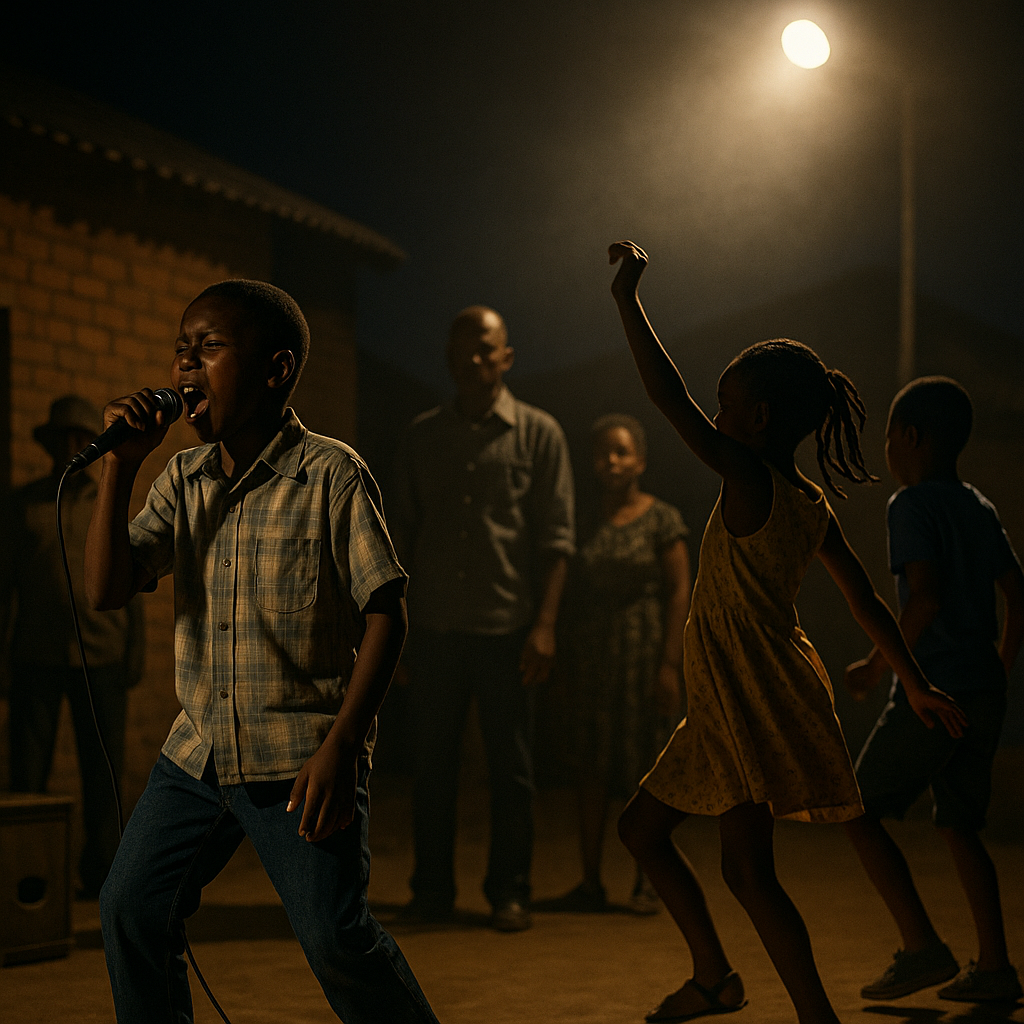
On a makeshift stage in Dzivarasekwa, his small hands steady the microphone as a Zimdancehall beat thunders through borrowed speakers.
He barely fills his oversized headphones, but his voice is sharp, confident, and practised.
Teenagers edge closer, vendors stop serving, and phones rise to capture the moment. Someone shouts, “Anopedza mfana uyu! ishasha iyi!” (This one is a star)
For Samson’s mother, that chant is not just hype.
It sounds like an escape from rent arrears, school fees and grocery debts. Each booking, each online view, each casual promise from a promoter feels like a possible way out.
Scenes like this are playing out across Zimbabwe as children sing at clashes and street festivals, front live bands, act in skits, dance on church stages and chase virality on TikTok, Instagram and YouTube.
Digital platforms have blown open the industry, turning homes, church halls and street corners into talent factories.
But beneath the applause and hashtags, parents, industry players and child rights experts warn that Zimbabwe’s child-star boom is unfolding in a fragile, poorly regulated space — one that can celebrate, commercialise and discard young performers long before they understand the price of early fame.
“Families see talent as a survival strategy,” said media and culture analyst Peter Kaviya.
“The danger is when a gifted child becomes the main economic plan in a system with no proper contracts, no savings structures, no counselling and no enforceable safeguards. That is a dangerous experiment on a young life.”
Samson’s family knows the pull.
His mother, who sells vegetables, says street performances and small shows help cover basics.
“If he is called, we go,” she said.
“Sometimes they say they will pay, sometimes it is exposure. We just hope one day it opens a big door.”
That hope rests on an industry many say is not built for children. Zimbabwe’s laws prohibit child labour and protect the right to education.
Still, they do not clearly spell out working hours, earnings management or on-set protections for children in entertainment and digital content.
Much of what happens is governed by verbal agreements, trust and pressure.
“There is a huge grey zone,” said child rights lawyer Memory Dube.
“A child can perform late at night, miss school for rehearsals, earn money that is controlled entirely by adults, or be pushed into content that exposes them online — and there may be no written contract, no independent oversight, no paper trail. When a dispute arises, it is the child who loses.”
Industry insiders admit the temptation to push young talent hard is real.
Promoters want the next viral act. Brands want fresh faces. Content creators want clicks.
Parents want relief.
Veteran broadcaster and arts promoter Simbarashe Maphosa, affectionately called DJ Templeman in music circles and has worked with young performers, said ethical guardianship must be non-negotiable.
“If you are handling a minor, you are handling somebody’s entire future,” he said.
“No child should perform without a clear agreement, limited hours, guaranteed schooling and a responsible adult who is not driven only by money. If those basics are missing, that opportunity becomes exploitation.”
Some managers and parents are trying to set a higher bar.
Harare-based artist manager and parent, Cynthia Wanyanya, insists on written agreements, time limits and transparent income tracking for minors she works with.
“We cap working hours, we make sure school is not disturbed, and every cent goes into a dedicated account,” she said.
“We also screen content; if the lyrics or costumes are not age-appropriate, it is a no. The industry needs to move in that direction as standard, not as a favour.”
But Wanyanya acknowledges her approach is not yet the norm. Many parents lack legal knowledge.
Some fear questioning promoters.
Others are dazzled by proximity to celebrities.
In a harsh economy, a short-term payout can matter more than long-term protection.
Psychologist and youth counsellor Dr Tawanda Moyo said the emotional risks are often ignored.
“Public criticism, bullying, sexualized comments online, adult expectations and unstable income can damage a child’s self-esteem,” he said.
“When the hype dies, some feel they have failed the family. They were never prepared for that fall.”
Zimbabwe already has a quiet catalogue of young talents who burst onto the scene and then disappeared when support systems collapsed — children who struggled to transition back into ordinary life, lost confidence, or never saw the benefits of the money they helped generate.
Families rarely speak openly for fear of stigma or conflict, but insiders say the pattern is familiar.
“You hear stories of children used for hit songs, for comedy skits, for ads, for campaigns,” Dube said.
“Years later, there are no savings, no education plan, no record of what they were owed. We cannot keep pretending it is just showbiz.”
Experts and stakeholders say part of the problem is that Zimbabwe’s creative economy is evolving faster than its protective frameworks.
The rise of social media child influencers, viral dance challenges, and monetised YouTube channels has outpaced traditional oversight tools designed for formal workplaces, not home-produced content viewed by millions.
Child protection organisations argue that clear minimum standards are overdue: written contracts for child performers; mandatory involvement of a legal guardian; caps on performance hours; guaranteed school attendance; age-appropriate content; confidential counselling support; and formal mechanisms to secure a share of earnings in trust funds accessible when the child comes of age.
They also call for regulators such as the National Arts Council, relevant ministries and professional associations to adopt and enforce a code of conduct for anyone working with child performers — from promoters and producers to talent managers and digital content creators.
“A child’s gift must never become a licence for adults to escape accountability,” Dr Moyo said.
“If the country celebrates young stars, the country must also be ready to protect them when the lights are off.”
For Samson, the spotlight still feels exciting.
He talks about recording an album, buying his mother a house, and helping his siblings. His dreams are big and sincere.
The real test is whether the adults around him — and the systems that govern Zimbabwe’s entertainment and digital spaces — can match that sincerity with structure.
Fame will continue to find children on street stages, in church pews and on smartphone screens.
The question is whether the nation chooses to consume their talent or build an environment where young performers can grow, earn, learn and step into adulthood with more than memories of a brief, burning moment under the lights.