

By Tendai Goredema
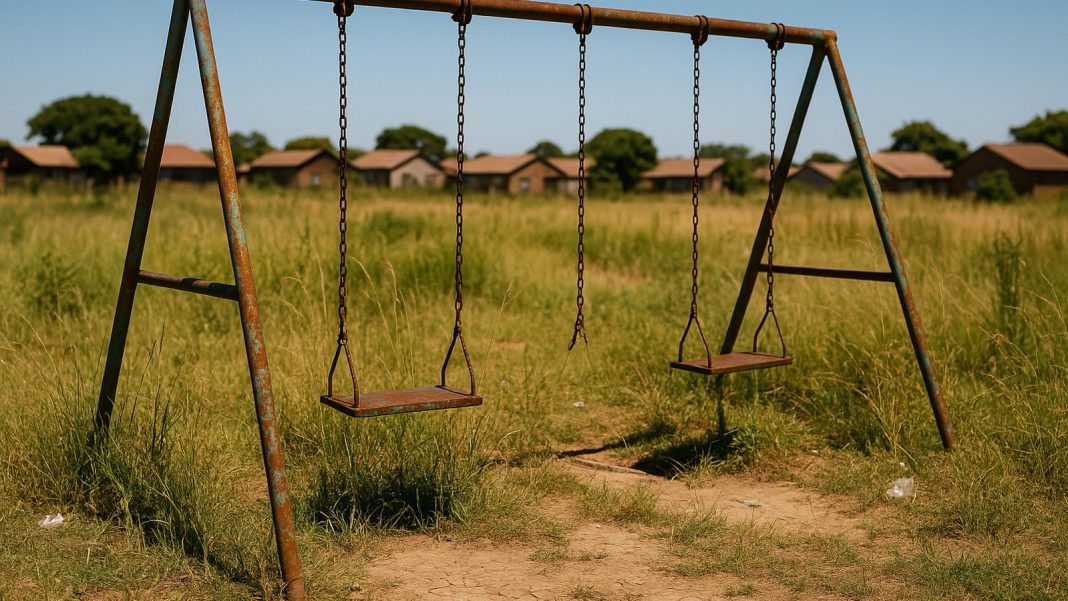
HARARE, Zimbabwe — A gentle breeze moves rusting swings in Matapi Recreational Park in Mbare.
Once a place of children’s laughter, community picnics, and football matches, the park is now overgrown, its playground equipment broken, its toilets non-functional, and its purpose long forgotten.
Across Harare and other urban centres, recreational spaces are vanishing — victims of land barons, underfunding, and government neglect.
The decay of these spaces signals more than lost infrastructure. For many, it’s the silent collapse of childhood in Zimbabwe’s townships.
“In Glen View 3, we had a full-time caretaker,” said Thomas Zinyemba, a retired Harare City Council employee.
“Now the grounds are taken over by vendors and used for political rallies. Children are no longer welcome there.”
Harare’s high-density suburbs — including Mufakose, Highfield, and Warren Park 1 — are particularly affected. At Highfield’s Zororo Grounds, what used to be a busy netball and soccer arena is now littered with waste, and in Glen Norah, football fields have been subdivided into housing stands.
“We used to have a park near our home,” said Rumbidzai Muchengeti, a mother of three from Highfield.
“Now, it’s a dumping ground. My kids stay indoors watching TV. They have nowhere safe to play.”
Her 11-year-old daughter, Tanatswa, added, “I miss the swings. And playing tag with friends on the grass. At home, I just get bored.”
The emotional and social void left by these abandoned parks is most evident among teenagers.
“We hung out at Stoddart Hall Grounds in Mbare to avoid trouble,” said Tawanda Chari, 19, from Glen Norah.
“Now, there’s nothing. You either stay inside or end up on the streets — and that’s where drugs and crime happen.”
Harare-based youth groups confirm this shift.
Rundown community centres like the Glen View Social Hall and Dzivaresekwa Grounds have been cited in media reports as hotspots for drug abuse and prostitution.
According to a 2022 Afrobarometer survey, 79% of Zimbabweans said drug abuse among youth is now “widespread.”
Experts say the lack of safe, positive spaces for recreation is part of the problem.
“Playgrounds aren’t luxuries,” said child psychologist Rujeko Mandizvidza.
“They are essential for physical development, emotional regulation, and social skills like teamwork. When we take these away, children don’t just lose play — they lose connection.”
Zimbabwe’s Constitution (Section 19) requires the state to provide recreational facilities for children.
So does Article 31 of the UN Convention on the Rights of the Child. Yet, a 2022 Active Healthy Kids Zimbabwe report card noted that no reliable data exists on the number or condition of parks in Zimbabwe.
“There are no policies or procedures to deal with the disrepair of public spaces,” the report warned.
In Harare, funding tells part of the story.
According to a 2024 gender budget analysis, less than 1% of the capital’s budget went to parks and conservation, while over 30% was channelled to water and sanitation.
“Councils have deprioritised sports and recreation,” said Harare Mayor Jacob Mafume.
“It’s a result of limited funds, but also years of neglect.”
Beyond neglect, there’s corruption.
“Land barons have taken over recreational land,” said Councillor Tafadzwa Machirori.
In Chitungwiza and Epworth, football fields have been carved up into illegal residential stands.
Harare Town Clerk Hosiah Chisango confirmed in 2023 that over 5,000 illegal stands were sold on land meant for clinics, schools, and parks ahead of elections.
In Bulawayo, the crisis takes a different form.
At Centenary Park and Barbourfields Park, vagrants have moved in as irrigation systems fail and city departments lack equipment to maintain the grounds.
“Only one borehole now serves our major parks,” a Bulawayo Parks Department official was recently quoted as saying.
“We don’t have fuel for tractors or water bowsers.”
Meanwhile, rural children may be physically active through chores and informal play, but they also lack equipped spaces.
Surveys show that 63% of rural children meet daily activity guidelines, compared to just 55% in urban areas.
There are, however, glimmers of hope.
“This is more than a playground,” said youth advocate Florence Karonga. “It’s a space for dignity, safety, and community.”
In Mbare, First Lady Auxillia Mnangagwa personally launched the renovation of Matapi Park in 2024.
The project included installing solar lights, repairing swings, and building toilets. “Today, we are reopening opportunities for our children,” she said at the launch.
The government has since directed all municipalities to allocate at least 7% of their 2025 budgets to sports and recreation.
Whether that translates into action remains to be seen.
For now, residents like Zinyemba and Karonga continue the work on the ground — organising clean-ups, advocating for funding, and rebuilding what was lost.
“The playground is more than equipment,” Karonga said.
“It’s where we shape futures.”
Who will step up to restore these forgotten spaces — and with them, the promise of childhood?