
By Witness Kudzanayi Roya
Africa cannot claim to build an inclusive digital future while millions of children still lack devices, affordable data, safe online spaces and a real voice in policies that shape their lives.
Africa keeps talking about the digital future.
Governments speak about artificial intelligence, e-learning, e-commerce, smart cities, innovation hubs, digital IDs and online public services.
But one question must guide that conversation: Where do children fit?
If Africa designs digital policies for adults only, it will deepen the same inequalities that already hurt children in classrooms, homes, clinics and communities.
A child who cannot go online cannot easily access homework, learning platforms, health information, child protection services, reporting channels, mentorship or opportunities to tell their own story.
Digital inclusion must therefore move from a development slogan to a child rights issue.
Children must not be left behind
The Sustainable Development Goals give Africa a useful starting point.
UN member states adopted the goals in 2015 to fight poverty, reduce inequality and improve lives by 2030. UNICEF says the goals call for a world where no one gets left behind and where countries deliver results for every child.
That promise must include the digital world.
Children need food, shelter, health care, clean water and education. But in the 21st century, they also need meaningful access to technology.
A child who lacks digital access not only misses entertainment. That child may miss online lessons, scholarship information, emergency updates, reporting platforms for abuse, health messages, digital skills and future employment opportunities.
In Zimbabwe, this gap remains visible.
A learner in Borrowdale may use fibre internet, a laptop and a smartphone to research schoolwork.
A learner in Buhera, Binga, Tsholotsho, Mudzi or Chipinge may rely on one parent’s phone, an unstable network and expensive data bundles.
That is not digital inclusion.
That is digital inequality in another form.
Zimbabwe shows both promise and the gap
Zimbabwe has made progress, but the numbers show that the country still has a long road ahead.
DataReportal says Zimbabwe had 6.54 million internet users at the end of 2025, with internet penetration at 38.4%.
It also says the country had 2.60 million social media user identities, equal to 15.3% of the population.
Those figures matter because they show that many people, including children, still live outside the digital space.
The COVID-19 period exposed that reality sharply.
UNICEF says about 4.5 million children in Zimbabwe lost nearly a year of schooling in 2020 after schools closed.
It also says digital learning reached only 6.8% of learners across the country, leaving poor and vulnerable children behind.
That experience should guide policy today.
When schools shut down, wealthy children often move online. Poor children often wait.
When teachers send work through WhatsApp, some learners download it immediately. Others borrow a phone at night, walk to a growth point for network coverage or miss the lesson completely.
When education moves online without equity, it rewards privilege and punishes poverty.
Zimbabwe has also shown what progress can look like.
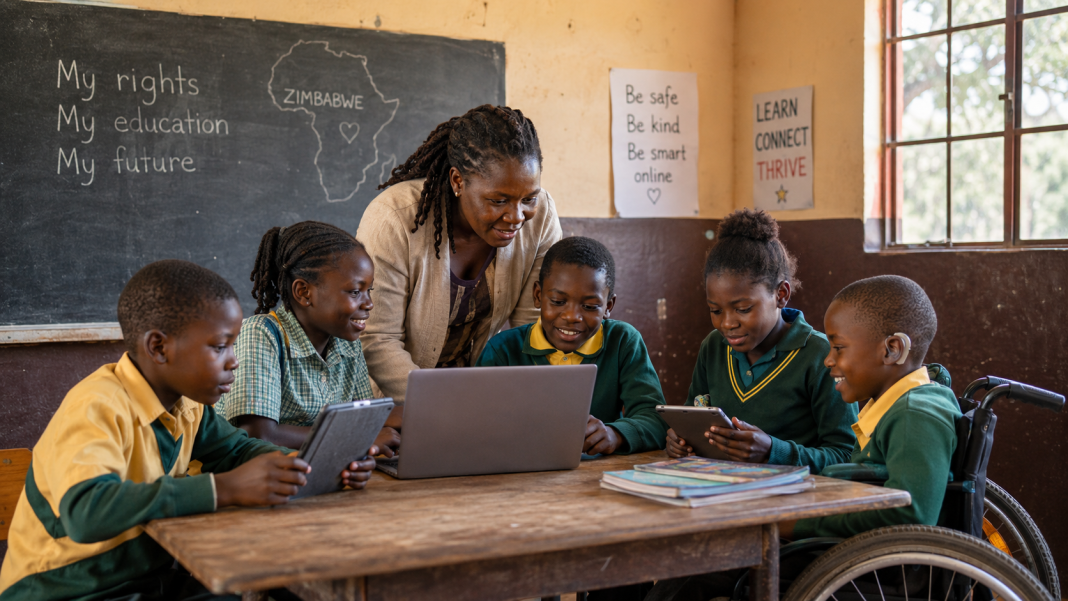
In January 2026, UNICEF handed over 815 laptops, 708 projectors and 2,112 tablets to the Ministry of Primary and Secondary Education.
The equipment targeted 113 disadvantaged schools in Manicaland and Matabeleland South and aimed to reduce the digital divide between urban and rural learners.
That intervention deserves recognition.
But Zimbabwe needs many more such efforts.
One donation cannot close a national digital gap. Government, mobile network operators, schools, development partners, churches, community groups and the private sector must treat digital access as part of basic education.
Children need devices.
They need affordable data.
They need electricity.
They need safe school-based digital hubs.
They need teachers who can use technology well.
They also need online spaces that protect them from abuse, exploitation, bullying, harmful content and manipulation.
Africa’s youngest population needs digital power
Africa cannot ignore children in digital planning because the continent’s future rests heavily on young people.
UNICEF says sub-Saharan Africa and South Asia will have the largest child populations in the 2050s.
That reality gives Africa both an opportunity and a warning.
If African countries invest in children’s digital access now, they can build a generation that creates technology, solves local problems, participates in democracy and competes globally.
If they fail, they will produce another generation of young people who watch the digital economy from the margins.
Digital inclusion must also include girls.
Many girls already face barriers in education, safety, unpaid care work and public participation. When families own one phone, boys may get more time with it.
When data costs rise, girls may lose access first. When online abuse goes unchecked, girls may silence themselves.
That is why digital inclusion must carry a gender lens.
African governments cannot talk about empowering girls while leaving them disconnected, unsafe or invisible online.
Africa can learn from practical examples
South Africa offers one useful example.
During the COVID-19 period, the country required zero-rating for certain educational and health websites. Zero-rating allows users to access specific online services without using mobile data.
South Africa’s Government Communication and Information System says ICASA requires mobile operators to zero-rate websites of public benefit organisations and government departments.
Zimbabwe and other African countries can adapt that idea.
Mobile operators can zero-rate approved education platforms, child protection websites, mental health services, examination portals and children’s rights information pages.
That would not solve every problem, but it would help poor families.
A child should not fail to read because a parent cannot buy data.
A child should not fail to report abuse because a reporting platform consumes data.
A child should not miss health information because access costs money.
Zimbabwe can also expand community digital hubs in rural schools, libraries, churches and ward centres.
FAO says digital hubs in Zimbabwe seek to bridge the rural-urban divide by offering free or low-cost internet access and digital skills training for rural households.
Such spaces can help children who have no devices at home.
But authorities must design them carefully.
They need child safeguarding rules, trained supervisors, safe browsing systems and inclusive access for children with disabilities.
Digital rights also need freedom
Digital inclusion does not only mean connection.
It also means freedom, safety and participation.
African governments cannot celebrate digital transformation while shutting down the internet during elections, protests or political tension.
Access Now says Africa recorded shutdowns in 15 countries in 2025, including Ethiopia, Kenya, Nigeria, Tanzania, Uganda and others.
The Guardian also reported that Africa experienced a record 21 internet shutdowns in 15 countries in 2024, based on Access Now and #KeepItOn data.
These shutdowns hurt adults, but they also hurt children.
They interrupt learning.
They cut access to emergency information.
They stop families from communicating.
They weaken children’s ability to participate in public conversations.
They also teach young people that governments can switch rights on and off.
Africa must reject that approach.
Digital inclusion cannot survive where governments treat internet access as a political favour.
Children need a seat at the table
Africa also needs to move beyond token child participation.
Zimbabwe and several African countries already use platforms such as junior parliaments and children’s parliaments.
The first African Forum of Children’s Parliament opened in Rabat, Morocco, on Nov. 21, 2025, as a continental platform to amplify children’s voices.
That development points in the right direction.
But children’s parliaments must not become ceremonial spaces where adults write speeches and children recite them.
Children must help shape digital policies that affect them.
They know the realities adults often miss.
They know how school WhatsApp groups work.
They know how online bullying spreads.
They know how children use TikTok, Facebook, YouTube, Instagram and gaming platforms.
They know how data shortages affect homework.
They know how rural learners struggle with network coverage.
They know how children with disabilities face extra barriers when platforms ignore accessibility.
Policymakers must listen to those experiences.
A digital policy that ignores children’s voices cannot claim to serve children.
The way forward
Africa must build a child-centred digital inclusion agenda.
That agenda should include affordable data for learners, zero-rated child protection and education platforms, rural digital hubs, solar-powered ICT facilities, teacher training, inclusive tools for children with disabilities and stronger online safety laws.
It should also include digital literacy from early school years.
Children must learn how to search for information, verify facts, protect personal data, report abuse, avoid harmful content and use technology creatively.
The private sector must also play its part.
Mobile operators, banks, technology companies and internet service providers benefit from Africa’s digital growth. They must invest in children, not only in profits.
They can support school connectivity, sponsor devices, zero-rate educational content, strengthen child safety tools and work with communities to reach marginalised learners.
Parents and guardians also need support.
Many children go online before adults understand the risks. Families need simple guidance on privacy, screen time, cyberbullying, online grooming, scams and digital footprints.
Africa must not choose between access and safety.
Children need both.
Africa must act now
The digital age has already arrived.
The question is whether Africa will allow only privileged children to benefit from it.
A continent that speaks of unity, renewal and development must not leave rural children, poor children, girls and children with disabilities outside the digital gate.
Africa’s digital future will not become inclusive simply because leaders mention technology in speeches.
It will become inclusive when a child in rural Zimbabwe can learn online without shame, report abuse without cost, use a device without begging, participate without fear and dream beyond the limits of poverty.
That is the digital inclusion Africa needs.
Phambili Africa.
Harambee Africa.
Dr Witness Roya is a postdoctoral research fellow with the Department of Digital Transformation and Innovation at the University of South Africa (UNISA) Graduate School of Business Leadership.