
John Mokwetsi
In rural Zimbabwe, a businessman, local leaders, and dedicated health workers are joining forces with UNICEF and partners to protect children from malnutrition, showing how community spirit, training, and timely support can change lives.
James Kahondo, a businessman in Gokwe South District—about 350 km from the capital, Harare—is transforming children’s lives one day at a time. His journey began with a chance encounter with a Village Health Worker during her routine community rounds, during which she screened children under five for malnutrition.
Kahondo vividly recalls the moment:
“She was deeply passionate about her work. The mothers, seated around her on a mat, listened intently. They didn’t even notice I was there. I had known about Village Health Workers before, but seeing her in action was a revelation. It struck me as such a selfless act of volunteerism. I knew then that I wanted to be involved.”
Then, Kahondo joined a community committee responsible for overseeing Chemahororo Clinic—an act of authentic community engagement and participation. The clinic, located 20 kilometres from the district’s shopping centre and main hospital, is accessed via a gravel road that branches off the main route and stretches for about 2 kilometres.
Kahondo explains: “I’m truly grateful for our health workers’ incredible work. I also appreciate the support we receive from UNICEF and our donors. But as a community, we must build sustainable models of healthcare. For now, we need to show our appreciation for the generosity we’re receiving by playing our part too. That’s why I offer my fuel and vehicles for the nurses to use during their outreach activities.”
The clinic’s community committee comprises dedicated local businesspeople and residents who support various initiatives that benefit everyone. One initiative is providing transport for health workers, especially for outreach points up to 30 kilometres from the nearest health facility.
Kahondo’s contributions have helped extend the reach of donor-funded initiatives, enabling more children to be reached and supported.
Health Leadership
At Chemahororo Clinic, excitement builds when the District Nursing Officer (DNO), Tinnie Mhlanga, arrives. Her role in the district shows the importance of her work: The DNO oversees all nursing services within a district. She supervises health facilities, ensuring quality of care and adherence to national health policies. She coordinates community health programmes, including immunisation, maternal and child health, and disease prevention.
Her community knows it, and she has been instrumental in coordinating the ongoing screening of children under five for malnutrition.
She said: “We run programmes closely collaborating with UNICEF, the Government of Zimbabwe and other partners. We’ve worked together on the Expanded Programme on Immunisation (EPI) and the Nutrition Programme. For these initiatives to be effective, we conduct outreach activities, for which we receive support regarding vehicle hire. However, the community also recognises the importance of preserving what we have, and that’s when they step in to help voluntarily. We have two local businesspeople and other members who form a community committee to help bridge the gaps we face, which is commendable.”
Turning to the child screening initiative, which has led to increased case identification and management, the District Nursing Officer (DNO) attributed its success to the vital support of Village Health Workers (VHWs).
“At this clinic, we currently work with 11 Village Health Workers and are training five more. Each VHW operates within its village and maintains a register of all the children in the area. They also collaborate with village heads, who keep a similar register and closely monitor what is happening in their communities. This coordination is beneficial, and the involvement of VHWs plays a key role in ensuring community health and the well-being of children,” the DNO said.
Donor and government Support are crucial
This community-driven work is part of a broader national effort supported by the Health Resilience Fund (HRF)—a pooled health fund coordinated by the Ministry of Health and Child Care with support from UNICEF and other partners. The HRF aims to strengthen health care for vulnerable mothers, newborns, children, and adolescents across Zimbabwe, especially in times of crisis.
In the last El Niño-induced drought of 2015–2016, Zimbabwe saw a 25% spike in the number of children needing treatment for severe acute malnutrition. The warning signs were clear. So this time, with another harsh El Niño looming, communities and partners acted early.
From village paths to national boardrooms, people came together. Care Groups and Village Health Workers intensified their efforts on the ground—visiting homes, educating mothers, and monitoring children’s growth. They weren’t alone. Agricultural partners worked hand in hand with health and nutrition teams. Community nutrition gardens were set up near water sources, and families learned to grow more resilient crops. Caregivers were trained to prepare nutritious porridge for young children, enriched with multiple micronutrient powders.
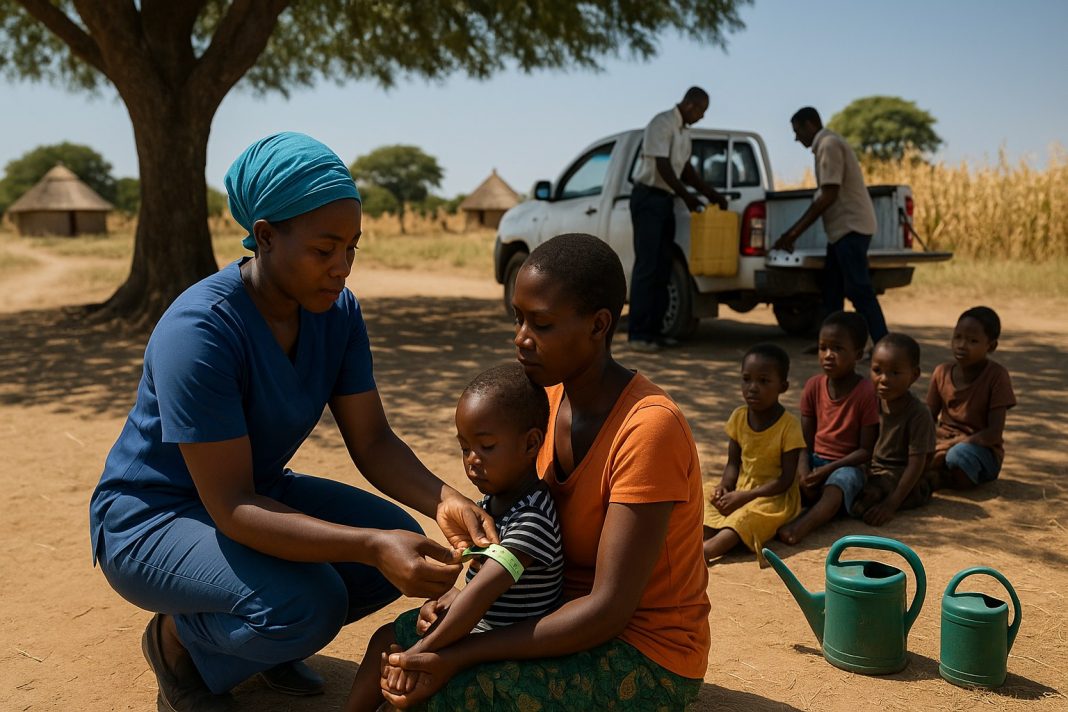
With support from the Health Resilience Fund (HRF), comprising the European Union, the Governments of Ireland and the United Kingdom, and Gavi, the Vaccine Alliance with the Central Emergency Response Fund (CERF), UNICEF and partners worked alongside the Ministry of Health and Child Care to expand MUAC screening across districts, ensuring no child’s condition went unnoticed.
The results were telling. In districts where care groups were active and different sectors worked together, children’s nutrition remained stable, even after the drought.
Village Health Workers
Takudzwa Tiengane, the District nutritionist at the Gokwe South District Hospital, said: “Thanks to support from UNICEF and the Health Resilience Fund, we have managed to train all 468 of our Village Health Workers in MUAC screening in Gokwe South. Before, only a small number were upskilled due to limited funding. Now, with this training, we’re identifying malnourished children much earlier and referring them for treatment, reaching even the hardest-to-access areas.”
She added that with sustained support from UNICEF and the Health Resilience Fund, village health workers have increased the number of children screened and reached communities previously left out due to distance and lack of resources. This has been critical in improving early identification and referral of malnourished children, especially during the El Niño-induced drought.
Blantina Munyanyi, a Village Health Worker, summarised: “The community relies on us. We navigate difficult terrain to reach remote villages, sit with families, and help them understand that children need specific diets, even with limited resources. I’m encouraged that we now have fewer cases to refer to the clinic, as we’re equipping caregivers with the right information.”
The story of Gokwe South stands as a powerful testament to what’s possible when government, community leaders, health workers, donors, and partners unite to improve the well-being of children.
Perhaps James puts it best: “When a community stands together, we can safeguard our future by promoting healthy living among our children, who are not only tomorrow’s leaders, but the heartbeat of who we are today.”