
By Tendai Makaripe
AI education in Zimbabwe deserves support.
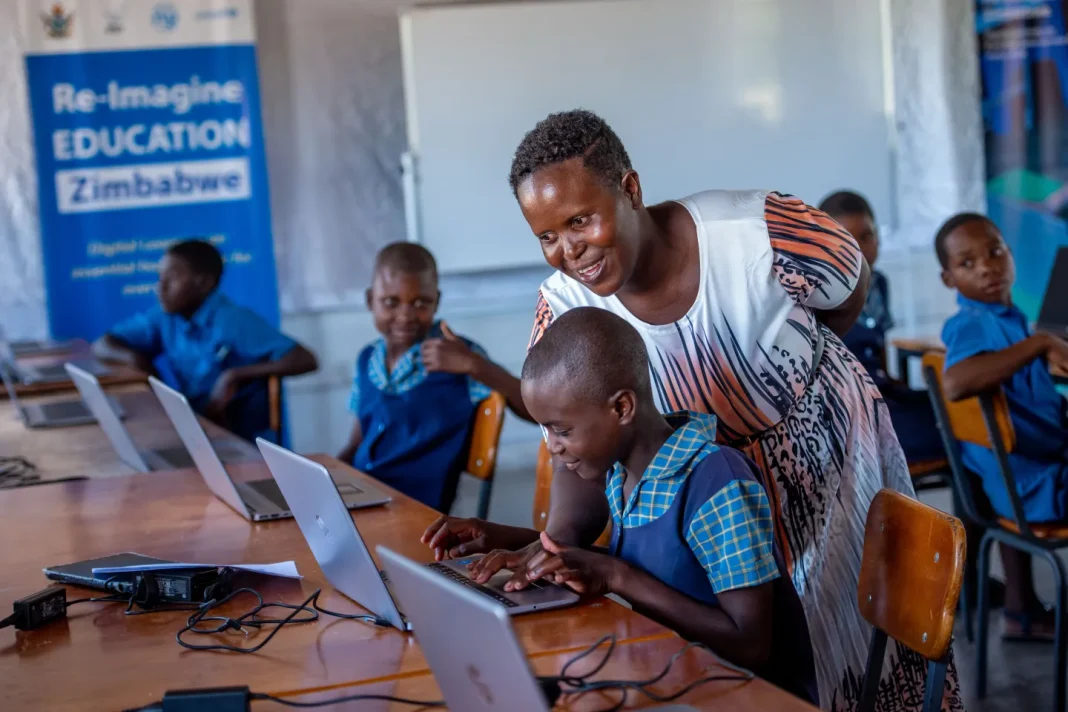
The country’s ambition to introduce artificial intelligence, coding and robotics in primary schools could prepare children for a future increasingly shaped by digital technologies.
AI already influences how people learn, work, communicate and access public services, and children need the knowledge to question, use and create these technologies.
But ambition alone will not produce equal opportunity.
If the government makes these subjects compulsory before every school can provide electricity, connectivity, equipment and trained teachers, it could turn a forward-looking reform into another measure of privilege.
Information Communication Technology, Postal and Courier Services Minister Tatenda Mavetera recently called for schools to make AI, coding and robotics compulsory from primary through secondary education.
She also promised curriculum reform, innovation laboratories, teacher training and wider access to devices and connectivity.
Her proposal deserves serious consideration.
However, her call does not constitute an approved compulsory curriculum.
That distinction matters because a compulsory subject creates a duty to give every learner a fair opportunity to study it.
Compulsion should mark the final stage of a funded rollout, not its starting point.
AI, coding and robotics also require different teaching approaches.
AI literacy helps learners understand how computer systems use data, produce outputs and sometimes reproduce bias.
Coding teaches them to write computer instructions, while robotics combines software, electronics and engineering.
Schools can teach some foundations through unplugged computing exercises, offline applications, shared devices and local learning materials.
These affordable approaches can help Zimbabwe begin quickly, but they cannot replace practical access.
Learners need reliable electricity, suitable devices, trained teachers, secure software and opportunities to experiment.
AI education in Zimbabwe needs reliable infrastructure
Energy Minister July Moyo said in April that about 75% of Zimbabwe’s schools had electricity.
He placed coverage at slightly more than 70% among primary schools and between 82% and 84% among secondary schools.
If the government mandates one curriculum before closing these gaps, well-resourced urban and private schools will offer laboratories and practical projects while rural and low-income schools struggle to provide demonstrations.
Examinations may then measure access to equipment as much as knowledge.
Zimbabwe could create a two-tier education system under the banner of innovation.
The Zimbabwe National AI Strategy 2026-2030 offers a more disciplined route.
It calls for age-appropriate modules, teacher retraining and equal access for rural communities and people with disabilities.
It proposes an initial cohort of 1,000 master AI teachers and a pilot in 100 schools before targeting curriculum coverage in 80% of schools during the 2028-2030 scaling phase.
This roadmap places preparation and testing before expansion. The government should follow it.
Teachers must lead Zimbabwe’s AI curriculum reform
Teachers need technical skills and training in AI ethics, misinformation, academic integrity, privacy, bias and age-appropriate teaching.
UNESCO’s AI competency framework promotes a human-centred approach that protects human agency and strengthens teachers.
AI should support teachers, not replace their professional judgment.
No algorithm should determine a child’s grades, discipline, school placement or educational future without human review, an explanation and an effective appeal process.
Zimbabwe must also protect children’s rights as it expands access.
The U.N. Committee on the Rights of the Child calls on governments to provide equal, meaningful digital access and involve children in policies that shape their digital lives.
Cabinet approved the Zimbabwe National Child Online Protection Policy 2026-2030 to address cyberbullying, online exploitation, harmful content, grooming, sextortion and privacy violations.
The Cyber and Data Protection Act also places duties on organisations that process personal information.
Schools must protect children using AI technology
Schools must apply those protections to every AI product.
Before officials approve a platform, they should require child rights assessments, data protection impact assessments and independent security reviews.
Contracts should identify what information the platform collects, why it collects it, where it stores it, who can access it and when the provider must delete it.
Schools should collect only necessary information.
They should prohibit providers from using learners’ work, voices, photographs, biometric information or personal details to train commercial AI models.
Schools should report breaches promptly and provide accessible complaint and remedy procedures.
Children with disabilities require particular attention.
AI can support captioning, text-to-speech tools, alternative communication and personalised assistance. Platforms that ignore accessibility can also create barriers.
The government must test accessibility with children who have different disabilities and require suppliers to meet enforceable standards.
Government must measure readiness for compulsory AI lessons
Before introducing compulsion, the government should publish a school-readiness audit covering electricity, connectivity, devices, teacher capacity, cybersecurity and accessibility.
It should set minimum standards, release a costed budget and prioritise underserved schools.
Officials should pilot the curriculum across all provinces and include rural, urban, public, private, satellite and special schools.
Independent evaluators should publish results by location, sex, disability status and school resource level.
Learners, teachers and parents should help design the curriculum and assess the pilot.
Zimbabwe should teach children to create technology rather than merely consume foreign systems. But speed alone will not demonstrate success.
A child in rural Binga, a learner with a disability in Buhera and a pupil at a well-equipped Harare school must receive a genuinely equal opportunity.
If Zimbabwe funds infrastructure, trains teachers, protects children’s data and evaluates its pilots honestly, AI education can transform learning.
If it rushes toward compulsion without those foundations, it will digitise inequality instead of defeating it.